


Winter EV Fleet Checklist: Charging, Tires & Visibility
Andrew MelamedA winter EV fleet checklist should do more than remind drivers to charge. It should give fleet managers a repeatable way to prepare vehicles, charging equipment, routes, tires, visibility systems, and shift handoffs before cold weather turns small gaps into missed departures.
Planning for a fleet? Explore The EDGE's bulk and customization options.
The strongest winter EV fleet checklist has five layers: vehicle readiness, charger and depot readiness, route and energy planning, driver procedures, and storm contingencies. Assign an owner to each check, follow the vehicle and charger manuals, and use the fleet's own winter performance data instead of one universal range or charge rule.
Use the checklist below as an operating framework. Adapt the details to each vehicle model, duty cycle, local requirements, and fleet safety policy.
What should a winter EV fleet checklist include?
A fleet-ready winter checklist connects charging, vehicles, drivers, and dispatch. Start with a pre-season baseline, then repeat the key checks before each shift. Include a charger inspection, route and charge plan, tire and visibility check, driver handoff, and a clear escalation path for a blocked route, failed charger, frozen connector, or vehicle that does not meet policy.
Make the checklist role-based so it works for a delivery fleet, service fleet, dealership, school operation, or mixed commercial fleet. The fleet manager owns the policy and reporting rhythm. A depot or maintenance lead owns charger and vehicle inspections. Drivers complete the shift-start walk-around and report exceptions before leaving.
| Checklist layer | Owner | When to review |
|---|---|---|
| Vehicle, tires, lights, glass, wipers, and mirrors | Driver and maintenance lead | Before each shift, with deeper seasonal checks |
| Charging cable, connector, holster, enclosure, and access | Depot or charging lead | Daily in freezing weather and after storms |
| Route, state of charge, weather, and fallback charging | Dispatch or fleet manager | Before assignment and when conditions change |
| Handoff, exceptions, and incident log | Driver and supervisor | At shift start, return, and after an event |
Do not use the checklist to create a universal state-of-charge threshold. A short urban route, a long rural route, a heavily loaded van, and a passenger shuttle may need different margins. Set the policy from the vehicle manual, route history, weather, payload, charger access, and local rules.
Before winter: build an EV fleet baseline
Winter planning is sharper when the fleet knows its normal baseline first. Record each vehicle's typical route, payload, terrain, charging location, comfort loads, and return state of charge. Then compare cold-weather results with that baseline. This reveals which routes, vehicles, chargers, or processes need extra margin before the first major storm.
Build one row for each vehicle or vehicle class. Record the manufacturer, battery and charging guidance, usual duty cycle, assigned routes, indoor or outdoor parking, and approved charging locations. Include the factors that change energy use, such as payload, hills, highway speed, cabin heat, defrosters, and frequent stops.
For a mixed fleet, avoid treating a sedan, delivery van, pickup, and bus as interchangeable. A bus-specific cold-weather study may offer useful planning principles, but it does not create a universal temperature, route, or charge rule for every vehicle. The DOE Alternative Fuels Data Center cold-weather guidance is useful context for fleet teams, while the vehicle manual remains the authority for model-specific operation.
- Record normal-weather route distance, payload, and energy use.
- List each vehicle's approved charging locations and connector type.
- Note whether cabin or battery preconditioning is available.
- Document which routes have a practical alternate charger.
- Set the person responsible for reviewing winter exceptions.
How should fleets prepare batteries, cabins, and charging plans?
Cold-weather charging plans should be vehicle-specific and route-aware. Where supported, schedule cabin and battery preconditioning while the vehicle remains connected to shore power. Allow for changed energy use and charging behavior, monitor weather, and plan a fallback. Do not copy a single vehicle's charge target or range loss into the whole fleet.
Cold weather can affect available range and charging behavior, while cabin heat, defrosters, and other comfort loads increase energy demand. The U.S. Department of Energy recommends warming the cabin and battery while an EV is still charging when the vehicle supports preconditioning. Read the DOE winterizing guidance alongside each vehicle's manual.
Turn that guidance into a fleet procedure:
- Confirm the scheduled departure and expected weather.
- Connect the vehicle according to the site and vehicle instructions.
- Use scheduled departure or preconditioning only when that model supports it.
- Check that the planned charge fits the route, payload, temperature, and available fallback.
- Record an exception when a vehicle cannot precondition, connect, or reach the fleet's configured departure policy.
For larger depots, stagger charging and preconditioning when site capacity or demand charges make simultaneous loads a concern. If a vehicle returns with less charge than expected, flag the route and conditions rather than quietly changing the next assignment. A manager can then decide whether to add a charging stop, swap vehicles, shorten a route, or delay departure.
Are the depot and EV chargers ready for snow and ice?
Charger readiness is a site and equipment check, not a windshield-clearing task. Inspect cables, connectors, enclosures, seals, holsters, lighting, drainage, and access lanes. Clear snow around equipment using the method approved for that site. Never force a frozen connector or use a scraper, hot water, or open flame around EVSE.
The New York Office of General Services recommends routine inspection of EVSE cables and connectors, attention to moisture and damage, and snow and ice control around charging equipment. Its cold-weather EVSE and fleet best practices also distinguish safe charger handling from ordinary exterior vehicle clearing.
- Check cable jackets, connectors, holsters, covers, and visible seals for damage.
- Keep access lanes, parking spaces, and equipment doors clear.
- Confirm lights, signs, drainage, and site access remain usable after a storm.
- Keep a dry, approved method for handling snow or ice near the equipment.
- Tag damaged equipment out of service and escalate it through the site's process.
- List an alternate charger or recovery plan before the primary site fails.
Keep The EDGE's vehicle-clearing role separate from EVSE handling. The EDGE is a paint-friendly, flat-stowing snow and ice scraper for vehicle surfaces. It is not a charging-port tool, and it should never be presented as a substitute for charger procedures or electrical safety controls.
What should EV drivers check before leaving?
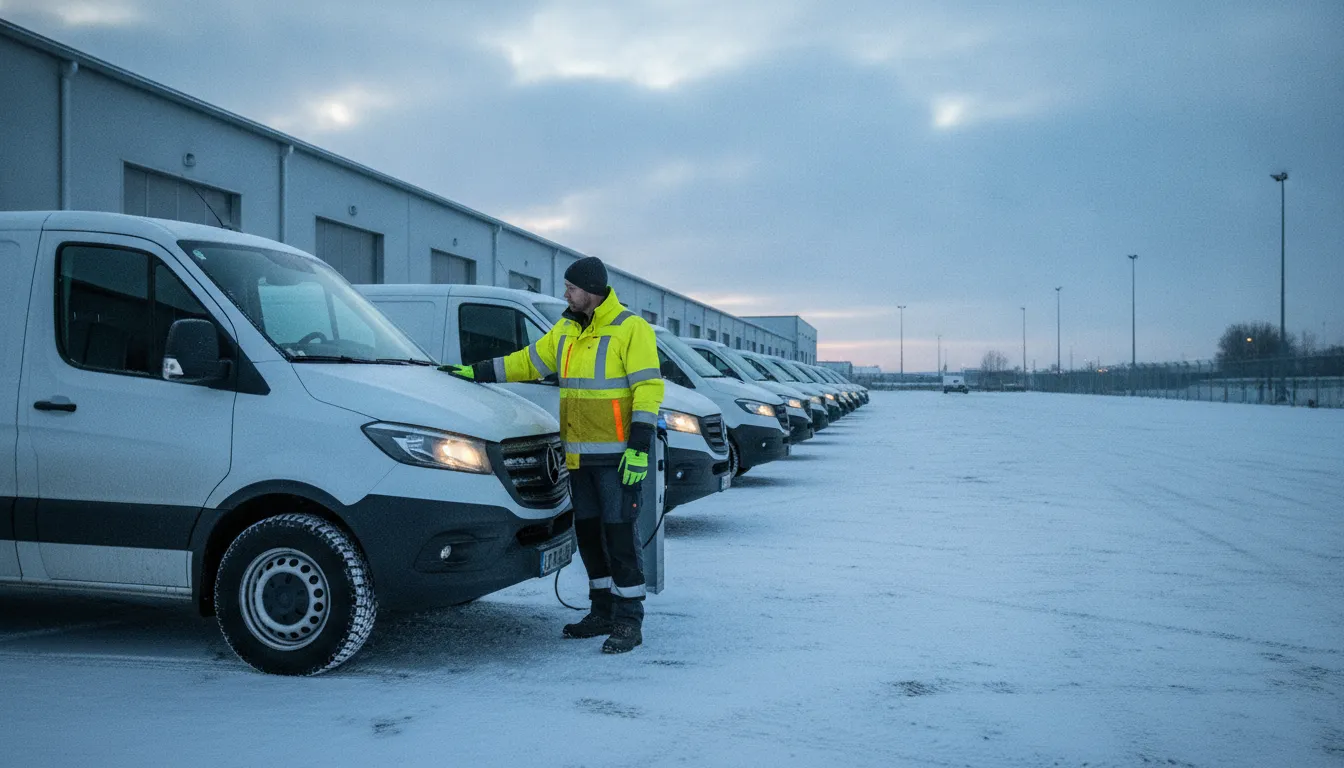
A shift-start walk-around turns winter readiness into a visible go or escalate decision. Drivers should confirm charge status and planned preconditioning, then inspect tires, lights, windows, mirrors, wipers, washer fluid, roof, and approved sensors or cameras. Snow and ice must be cleared before departure, and exceptions must be reported before the route begins.
Use a short card that can be completed under pressure. The NHTSA winter driving guidance recommends clearing snow, ice, and dirt from windows, forward sensors, headlights, taillights, backup cameras, and other sensors. It also recommends checking tire pressure when tires are cold and following the vehicle manufacturer's recommended pressure.
- Charge: Confirm the planned departure charge and any scheduled preconditioning.
- Tires: Check pressure, tread, visible damage, and the fleet's approved winter tire setup.
- Visibility: Clear every window, mirror, light, camera, and approved sensor area.
- Wipers: Check blade condition, washer fluid, and front and rear defroster operation.
- Exterior: Remove loose snow and ice from the vehicle surfaces before moving.
- Cabin: Confirm required supplies and the approved escalation contact.
- Decision: Report anything outside policy before leaving the depot.
Do not scrape or pour hot water onto charging equipment while clearing the vehicle. If a charging connector, door, wiper, or sensor is frozen, follow the vehicle and equipment instructions rather than forcing it.
How should fleets plan winter routes and contingencies?
Route planning should test the real winter duty cycle, not rely on advertised range alone. Match vehicles to routes using temperature, payload, terrain, traffic, HVAC demand, tire setup, and charger access. Give dispatch a clear trigger for a vehicle swap, added charge stop, route change, delayed start, or support call.
Build a simple route worksheet for every weather alert:
| Field | Decision to record |
|---|---|
| Route and vehicle | Which vehicle is assigned, and why it fits the duty cycle |
| Expected conditions | Temperature, precipitation, wind, terrain, traffic, and payload |
| Energy plan | Starting charge, planned charging, and the fleet's configured reserve policy |
| Fallback | Alternate charger, vehicle swap, shortened route, or approved delay |
| Owner | Who monitors the route and who receives an exception call |
Monitor weather and road conditions before dispatch and during an active event. If the vehicle's actual energy use, charging access, or visibility condition falls outside policy, safety takes priority over completing the original route. Document what happened so the next winter assignment improves.
How can fleet managers standardize winter handoffs?
Standardized handoffs prevent the next driver from inheriting an unknown problem. Require a simple record of charge status, charger exceptions, tire or visibility concerns, supplies used, and maintenance needs. A consistent handoff helps supervisors spot patterns across vehicles instead of treating every winter delay as a one-off.
Use a shared paper or digital log with five fields: vehicle ID, time, check result, exception, and owner. The driver records what was seen. The supervisor assigns the next action. Maintenance closes equipment or vehicle issues. Dispatch updates route assignment when the exception affects range, charging, visibility, or availability.
For a broader process layer, link this article's EV-specific workflow to The EDGE's winter vehicle prep checklist for rental fleets. The audiences differ, but its repeatable walk-around and handoff logic can help a commercial team standardize inspections without copying its rental-specific scope.
After each major storm or cold snap, review planned versus actual route completion, charging time, unexpected energy use, charger faults, tire issues, visibility reports, and driver feedback. Update the route worksheet and training card while the details are still fresh.
Where does The EDGE fit in a winter EV fleet plan?
The EDGE supports the vehicle-exterior portion of a winter fleet routine. Its large, paint-friendly edge helps crews clear snow from vehicle surfaces, while the flat design is easy to stow. The Wiper Blade Clearing Groove adds a dedicated clearing function. It does not replace tires, charger procedures, vehicle manuals, or fleet safety policy.
Equip every vehicle with winter-ready clearing gear from The EDGE.
The EDGE measures 18 inches wide by 14 inches long, stows flat, and is designed for push or pull use on vehicle surfaces. Its Wiper Blade Clearing Groove helps remove ice accumulation from blades. These features make it a practical item to standardize at a depot or in a vehicle kit when a fleet is already building a consistent visibility routine.
For commercial buyers, The EDGE supports bulk and customization conversations for fleet teams, dealerships, delivery services, and other organizations. Visit the The EDGE enterprise page for fleet and bulk-order information, or use plain-text text-to-order at (833) 805-7733. Keep the product recommendation in its proper lane: clear vehicle surfaces, then follow the rest of the fleet's safety procedure.
Frequently asked questions
How does cold weather affect an EV fleet?
Cold conditions can affect available range and charging behavior, while cabin heat and defrosters add energy demand. The size of the effect varies by vehicle, battery, temperature, route, payload, speed, tires, and weather. Use the vehicle manual and the fleet's own route data instead of a universal percentage.
Should EV fleets precondition vehicles while plugged in?
When a vehicle supports preconditioning, warming the cabin and battery while connected can preserve more battery energy for the route. The exact feature, timing, and procedure vary by model. Follow the vehicle manufacturer's instructions and record a fallback for vehicles that cannot precondition.
Do EV fleets need winter tires?
That depends on local weather, road conditions, vehicle requirements, load, and fleet policy. Inspect tire pressure and tread, and choose tires that meet the vehicle manufacturer's size and load requirements. Do not choose a tire solely because it is marketed for EVs.
Can The EDGE be used around an EV charging connector?
No. Use The EDGE for appropriate vehicle exterior surfaces, not for charging connectors, EVSE enclosures, or electrical equipment. Follow the charger and vehicle instructions for snow, ice, moisture, and frozen connectors. Never force a connector or use hot water or an open flame around EVSE.
What should a fleet do when a charger fails during a cold snap?
Use the preassigned escalation path: protect the vehicle and people, report the fault, move to an approved alternate charger or vehicle when available, and update dispatch. The right action depends on the site's equipment, route, fleet policy, and local conditions, so define it before the weather event.
Ready to equip your winter fleet?
Talk with The EDGE about bulk, branded vehicle-clearing tools for your fleet.