


Remove Snow From Car Roof: The Safe Way to Do It
Andrew MelamedA roof covered in snow is not harmless cargo. A hard stop can send a heavy sheet across the windshield, while loose ice can blow into the path of the driver behind you. Snow and ice removal also protects visibility and helps you avoid preventable trouble on the road.
Ready to upgrade? The EDGE has you covered.
To remove snow from car roof safely, clear the roof before driving, then finish the hood, windows, lights, mirrors, and tailpipe with a paint-friendly tool that gives you reach without forcing you to climb. In several states, leaving snow or ice on your vehicle can also lead to fines, including $25 to $75 per offense in New Jersey. New Jersey safety guidance says to remove it before you go.
The right clearing routine turns a frustrating winter chore into a safer pre-trip habit. Start with why roof snow creates more than an inconvenience, then build a top-down approach that keeps your vehicle and everyone around it safer.
Why You Need to Remove Snow From Your Car Roof Before Driving
Roof snow is not harmless cargo. It is a moving hazard that can block your view, affect vehicle handling, and put everyone nearby at risk.
When you brake, a packed layer can slide forward from the roof onto the windshield. Visibility can disappear at the exact moment you need a clear view of traffic, pedestrians, and stopped vehicles. Snow and ice can also shift across the hood or rear glass, leaving you with blind spots that no defroster can fix instantly. Clearing the roof is part of a complete winter driving safety checklist, not an optional morning chore.
Snow on the roof can become a road hazard
Loose snow may blow off as you gain speed. Hard-packed ice can break free in larger pieces. Either can strike a following vehicle, damage its windshield or body, or injure another driver. The risk does not end when your own windows are clear. Every driver shares responsibility for keeping avoidable hazards off the road.
That is why New Jersey's official guidance tells motorists to remove ice and snow before driving. If flying snow or ice causes property damage or injury, the state says fines can range from $200 to $1,000 per offense. The rule reflects a practical truth: a few minutes spent clearing the vehicle can prevent a serious chain reaction.
Snow can affect handling and create a carbon monoxide threat
Snow left across the roof adds uneven weight high above the vehicle's center of gravity. As it shifts, it can affect balance and handling, especially during turns, braking, or sudden lane changes. A clear roof supports more predictable control in winter conditions.
Do not overlook the tailpipe. If snow blocks the exhaust outlet, carbon monoxide can build inside the passenger compartment. Research cited in the fact ledger found lethal levels in a closed vehicle within 2.5 minutes when the tailpipe was obstructed. Before starting a buried vehicle, make sure the exhaust path is completely clear and keep the vehicle outdoors.
Clear the roof, hood, windows, lights, mirrors, and tailpipe before you go. Scrape. Stow. Go.
What Happens If You Drive With Snow on Your Roof
Roof snow does not stay put just because the vehicle is moving smoothly. Braking, turning, wind, and rising temperatures can shift a packed layer without warning. The result can be a sudden visibility problem, a dangerous road hazard, or a costly traffic violation.
Snow can slide forward onto the windshield. A roof covered in loose snow may spill over the glass when you slow down or stop. That instant loss of visibility can leave you reacting to traffic, pedestrians, or a turn before the windshield clears. Snow can also slide backward onto the rear window, blocking your view of vehicles approaching from behind. New Jersey's traffic-safety guidance specifically tells motorists to remove ice and snow from the hood, windows, and roof before driving. The New Jersey Attorney General's safety guidance treats clearing the vehicle as a basic winter-driving responsibility.
Hard-packed snow can become an ice missile. As speed and wind increase, a frozen sheet can break free from the roof and fly into the lane behind you. It may strike a following car's windshield, hood, or lights, or force another driver to brake and swerve. The New Jersey guidance warns that flying ice or snow can cause property damage or injury, with fines ranging from $200 to $1,000 when that happens. The risk is not theoretical just because your own windshield is clear.
Following distance helps, but it does not solve the source problem. In winter weather, New Jersey recommends leaving at least 8 to 10 seconds between vehicles so drivers have more time to respond to sudden stops and hazards. That extra space may reduce the severity of a close call, but it cannot make a roof load safe to transport. Clear the roof before entering traffic.
A ticket may be waiting even when nothing flies off. It is illegal to drive with snow on a vehicle in approximately 11 states, including New Jersey, Connecticut, Massachusetts, Michigan, and Wisconsin. In New Jersey, failing to remove snow and ice can bring a $25 to $75 fine per offense, whether or not anything becomes dislodged. Check local rules, then make a clean roof part of every winter departure.
How to Remove Snow From Your Car Roof the Safe Way
Clear the vehicle before you drive, not just the glass in front of you. A clean roof, hood, windows, lights, mirrors, and tailpipe improves visibility and keeps loose snow from becoming a hazard. The safest method is simple: work from the highest surface down, use the right tool, and let the vehicle's paint and glass stay untouched by harsh edges.
-
Clear the tailpipe first
Before starting the engine, check the tailpipe and remove any packed snow around it. A blocked exhaust can send carbon monoxide into the passenger compartment. In a vehicle test, lethal carbon monoxide levels developed within 2.5 minutes with the windows closed, while an unobstructed tailpipe produced zero carbon monoxide. Read the published safety study, then make tailpipe clearance your first move.
-
Start at the roof and work downward
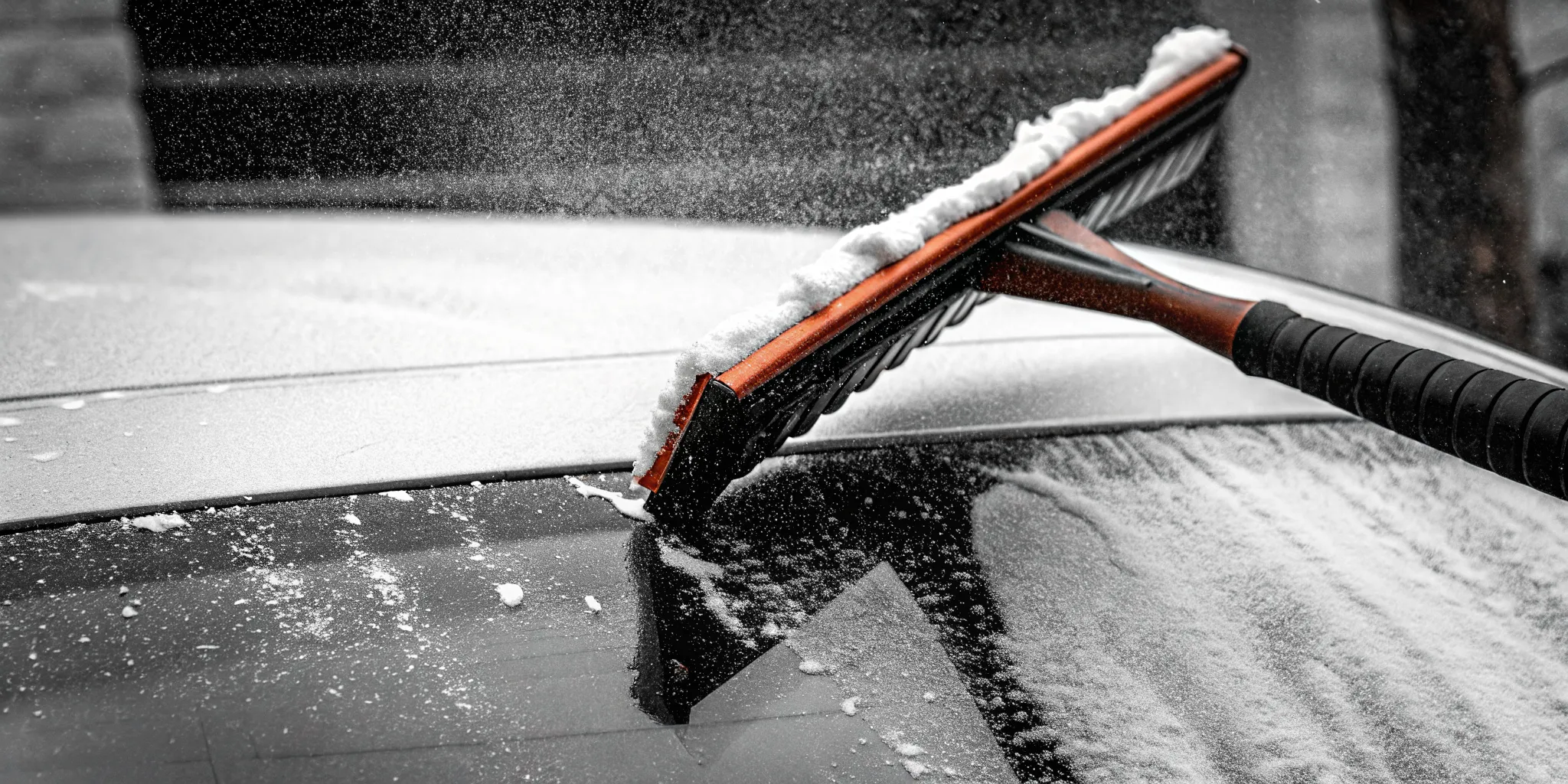
Use a long-handled brush or specialized scraper so you can reach the roof without leaning across the vehicle or dragging clothing against the finish. Push snow off the roof in controlled passes, moving away from the windshield and doors. A long tool makes the job easier and safer for the paint than a short tool that forces you to stretch or press hard.
Elevate your gear with a premium winter scraper at The EDGE.
-
Clear the hood, then the trunk
Once the roof is clean, move to the hood and trunk. Keep each pass deliberate. Do not shove a heavy, frozen slab across the surface if it resists. Break up stubborn areas with a paint-friendly edge and lift loose pieces away. The goal is a clean vehicle without grinding grit into the finish or creating micro-scratches.
-
Finish the windows, lights, and mirrors
Clear every window, headlight, taillight, and mirror before pulling out. Do not settle for a narrow viewing patch through the windshield. Snow on the hood or roof can shift during braking, while covered lights and mirrors reduce your ability to see and be seen. New Jersey safety guidance recommends removing ice and snow from the hood, windows, and roof before driving.
-
Use paint-friendly tools and light pressure
Never reach for a metal tool, rough-edged scraper, or stiff-bristled brush on painted panels or glass. Those shortcuts can leave scratches where a controlled pass would do the job. Choose a tool designed for vehicle surfaces, keep the edge clean, and use steady pressure instead of forcing it. Go gently on painted panels while getting the snow off.
That roof-to-ground sequence keeps the process organized and reduces missed surfaces. Clear it completely, check the tailpipe again if snow is falling heavily, and drive only when the vehicle is ready.
The Best Tool for Roof Snow Removal: The EDGE 18-Inch Snow Scraper
For large roof areas, the right tool should move snow efficiently without turning winter prep into a wrestling match. The EDGE brings a super-sized 18-inch-wide by 14-inch-long design to the job, helping clear broad surfaces with significantly less effort than a small scraper. Its paint-friendly edge is built for repeated winter use, while its flat profile makes stowage simple.
| Tool. | Paint care. | Speed on large areas. | Roof reach. | Stowage. |
|---|---|---|---|---|
| The EDGE. | Paint-friendly Rubber Snow Plow. | Clears an 18-inch band with every pass. | Wide face covers more roof per pass. | Stows flat or upright. |
| Standard snow brush. | Depends on bristle softness and technique. | Better for light snow than packed accumulation. | Handle can help reach, but brush head covers less area. | Usually narrow and easy to stow. |
| Small hand scraper. | Depends on edge condition and pressure. | Slow across a large roof. | Limited by its short handle and small head. | Compact. |
| Shovel. | Not designed for vehicle paint. | Moves volume, but can be awkward on a vehicle roof. | Reach varies, with less control near the vehicle surface. | Bulky. |
Why surface coverage matters
A roof scraper that covers more ground can reduce repeated strokes and unnecessary strain, especially on SUVs, vans, and other taller vehicles. The EDGE is built to clear large roof areas with minimal effort. Its durable construction is made to keep working through harsh winter conditions, unlike flimsy plastic tools that can flex, crack, or wear down under pressure.
Snow is not the only problem
Winter precipitation can pack into stubborn ice accumulation. The EDGE is designed to help remove ice as well as loose snow, giving you one tool for more of the cleanup routine. Use controlled pressure and a clean edge, especially around painted surfaces and glass.
See the snow brush vs. snow scraper comparison, then check out The EDGE snow scraper for a tool that is faster, stronger, built to last, and easy to stow flat.
Snowbelt State Laws That Penalize Uncleared Roof Snow
In many snowy states, clearing your vehicle is more than courteous winter prep. It can be a legal requirement. The Drive identifies 11 states where driving with snow on your car can be illegal: Alaska, Connecticut, Georgia, Massachusetts, Michigan, New Hampshire, New Jersey, Pennsylvania, Rhode Island, Tennessee, and Wisconsin. Laws differ by state, so check the rules where you drive instead of assuming one standard applies everywhere.
New Jersey puts a price on flying snow and ice
New Jersey takes a direct approach. Drivers who fail to remove ice and snow from a vehicle can face a $25 to $75 fine for each offense. Even if the material never falls from the vehicle. If flying ice or snow causes property damage or injures someone, the fine can rise to $200 to $1,000 per offense.
That is why the New Jersey Attorney General promotes "Ice and Snow, Remove It Before You Go". The message is simple: clear the roof, hood, windows, and other vehicle surfaces before entering traffic. A packed roof can become a sliding sheet when you brake or a hard projectile when wind lifts it at speed.
Wisconsin treats snow removal as winterization
Wisconsin drivers should think beyond a single scrape before work. The Wisconsin Department of Transportation includes snow and ice removal in a broader winterization routine that also covers tires, fluids, and wiper blades. Its guidance reinforces a practical habit: prepare the entire vehicle before the trip, not just the windshield.
Before you pull out, walk around the vehicle. Remove loose snow and ice from the roof, hood, trunk, lights, mirrors, and windows. Clear the tailpipe if snow has accumulated around it. Then review your state and local requirements, particularly if you cross state lines. A few extra minutes of preparation can prevent an avoidable ticket, blocked visibility, or dangerous debris on the road.
For state-specific guidance and current enforcement details, start with your state transportation or public safety agency. Rules and penalties can change, and the safest assumption is not that roof snow is harmless, but that it belongs off the vehicle before you go.
Frequently Asked Questions
Should you remove snow from the roof of a car?
Yes. Clear the roof before driving, along with the hood, windows, lights, mirrors, and around the tailpipe. Snow or ice can slide forward during braking, block your visibility, or fly onto vehicles behind you. Removing it is a basic winter safety step, not just a cosmetic one.
Is it illegal to drive with snow on your car roof?
It can be. Several states, including New Jersey, Pennsylvania, Massachusetts, and Wisconsin, have laws or enforcement provisions covering uncleared snow and ice. In New Jersey, failing to remove it can bring a $25 to $75 fine per offense, while snow or ice that causes property damage or injury can lead to fines of $200 to $1,000. New Jersey's highway safety guidance explains the requirements.
How can you remove snow from a car roof with care?
Use a soft snow brush or a specialized scraper with a paint-friendly edge. Work from the roof downward, use controlled strokes, and avoid rough-edged tools or stiff bristles that can mark paint or glass. For packed ice, loosen the surface carefully instead of forcing a sharp edge across the finish.
What tools are best for removing snow from a car roof?
Choose a tool with enough reach and surface area to clear the roof without leaning across the vehicle. The EDGE has an 18-inch-wide by 14-inch-long design, a paint-friendly edge, and a flat profile for stowage. Its larger surface is built to clear broad areas with less effort than a small scraper. See The EDGE.
Ready to Get The EDGE Snow Scraper?
A clear roof starts with the right tool. The EDGE gives you a broad, paint-friendly surface for tackling snow and ice across your vehicle before you pull away. Keep winter prep simple, controlled, and ready for the road. Get The EDGE snow scraper and make safe roof clearing part of every winter drive.