


Is a Snow Pusher Worth It? Pros, Limits, and Better Options
Andrew MelamedA snow pusher can make a broad driveway or walkway easier to clear, but it is not a universal winter tool. The right answer depends on the surface, the snow condition, the space available, and whether the job requires pushing, lifting, scraping, or breaking up ice.
Ready to upgrade your vehicle winter setup? The EDGE has you covered.
Is a snow pusher worth it? Usually, yes, when you need to move loose snow across a broad, mostly level ground surface. A shovel is better for lifting and tight spaces. A vehicle scraper belongs in a separate category because it clears snow and ice from windows, roofs, hoods, and wipers rather than pavement.
That distinction gives you a practical way to choose. Match the tool to the surface first, then consider snow depth, effort, storage, and the distance the material must move. A good winter setup may include more than one tool, with each one assigned to the job it handles best.
Is a snow pusher worth it for a driveway or walkway?
A snow pusher is worth it when the main task is moving loose snow across an open, mostly level surface. Its wide blade can keep snow on the ground instead of turning every pass into a scoop and lift. That makes it useful for driveways, sidewalks, patios, and other routes with a clear destination.
A pusher earns its place when you can maintain a steady path. You move the tool forward, direct the snow toward an edge or clearing area, and avoid repeatedly loading a blade. This can feel more controlled than lifting scoop after scoop, especially when the snow is light and the route is wide.
It is less useful when the snow is trapped in corners, piled against a door, or built into a high bank. A pusher also has limits on uneven ground and narrow paths. If you need to lift snow over an edge, place it precisely, or clear steps, a shovel remains the more flexible choice.
Where a pusher works best
Look for three conditions: loose snow, a broad surface, and somewhere to send the snow. A long driveway with room along one side is a natural fit. So is a walkway where the snow can be pushed forward without running into steps, parked vehicles, or a gate.
Timing matters, too. Clearing lighter accumulation in manageable passes is usually more practical than waiting until a large, heavy layer blocks the route. If the load becomes difficult to move, reduce the amount in front of the blade. Do not force a tool simply because its blade is wide.
The answer is not that a pusher replaces every other tool. It is that the pusher handles one job directly: moving loose snow across open ground. If the property includes steps, tight corners, heavy banks, or vehicles, plan on keeping a shovel and a dedicated vehicle scraper available.
Snow pusher vs shovel: which tool fits the job?
A snow pusher is designed to move snow with less lifting, while a shovel is designed to scoop, lift, and place snow with more precision. Choose the pusher for open routes. Choose the shovel for steps, edges, deep piles, narrow spaces, and any place where snow must be lifted or redirected.
| Factor | Snow pusher | Snow shovel |
|---|---|---|
| Best surface | Broad, mostly level driveways and walkways. | Steps, edges, corners, narrow paths, and uneven areas. |
| Main motion | Pushes a layer forward or to the side. | Scoops, lifts, carries, and places snow. |
| Snow condition | Loose snow that can slide across the surface. | Uneven, deeper, piled, or difficult-to-place snow. |
| Effort pattern | Fewer lifts when the route is clear. | More lifting, but greater control in confined areas. |
| Storage | Long handle needs wall, shed, or garage space. | Often easier to hang, depending on the design. |
Choose pushing when the route is open
Pushing makes sense when the snow can stay on the ground until it reaches a pile or clearing area. Keep your path straight when possible. Turn the blade or change direction only when the layout requires it. If the pusher begins to bind, reduce the load instead of leaning harder into it.
That workflow is especially useful on broad surfaces. It also makes the pusher a poor choice for every detail job. The blade is not meant to replace the control of a shovel around steps, door thresholds, parked cars, or narrow gates.
Choose a shovel when lifting or precision matters
A shovel gives you a smaller working load and more freedom to change direction. Use it when snow must be lifted over a bank, moved into a tight pile, cleared from steps, or removed from a narrow strip. It is also the better backup when a pusher cannot reach a corner.
The practical verdict is often both tools, not either-or. Use the pusher for the long, open sections. Keep the shovel close for the places where pushing stops being efficient. That division reduces the temptation to use the wrong tool simply because it is already in your hands.
What changes when snow is deep, wet, packed, or icy?
Snow condition can change the value of a pusher more than the size of the surface. Loose snow is the easiest match. Wet snow needs smaller passes. Deep buildup is easier to manage in layers. Packed snow and bonded ice may require a separate method before either a pusher or shovel can finish the job.
Light, loose snow is the clearest use case. It can slide forward without creating a heavy wall in front of the blade. As snow becomes deeper or wetter, resistance increases. Shorter passes and smaller loads help keep the tool under control.
Deep accumulation deserves a measured approach. Do not wait until the full depth has to move at once if you can clear in stages. Work from an accessible edge, reduce the amount in each pass, and leave yourself a route to the next section. A pusher may still help, but the advantage comes from managing the load rather than overpowering it.
Wet snow is heavier than a light powder. A wide blade can collect a substantial amount quickly, so a full-width pass may be harder to control than expected. Use smaller bites. Stop when the blade starts to bind. More short passes are preferable to forcing a heavy load.
Packed snow and ice are the boundary. A pusher is not automatically an ice breaker, and a shovel is not automatically a safe tool for every frozen surface. Use a suitable de-icing or ice-loosening method when needed, then move the loosened material. Avoid striking surfaces or using excessive force where damage could result.
These limits do not make a snow pusher pointless. They define when it earns its place: open ground, manageable depth, a clear direction, and snow that can move. When those conditions disappear, switch tools or reduce the load instead of treating the pusher as a substitute for powered equipment or a specialized ice tool.
Why is a snow pusher worth it if you still need a vehicle scraper?
A snow pusher clears the path to your vehicle. A vehicle scraper prepares the vehicle itself. They are not competing tools. One is built for ground-level snow movement, while the other is built for snow and ice on glass, paint, roofs, hoods, and wiper blades. Keeping those roles separate leads to a more useful winter setup.
A driveway pusher is the right category for clearing ground surfaces. It is shaped around moving snow toward an edge or pile. A vehicle scraper needs a different contact surface and a different level of control because the work happens on a car, truck, or SUV.
Using a ground tool on a vehicle is a poor tradeoff. A large handle can make close work awkward. A stiff or unsuitable edge can create unnecessary risk for the finish. A vehicle tool should be selected for the surfaces it touches and the areas it needs to reach.
The EDGE is built for vehicle winter preparation rather than driveway clearing. Its broad 18 by 14 inch format uses a push-and-pull design for snow and ice on vehicle surfaces. The product page also describes a paint-friendly edge and a Wiper Blade Clearing Groove for removing ice buildup from wiper blades.
See The EDGE for vehicle snow and ice removal.
Elevate your winter gear with a purpose-built vehicle scraper from The EDGE.
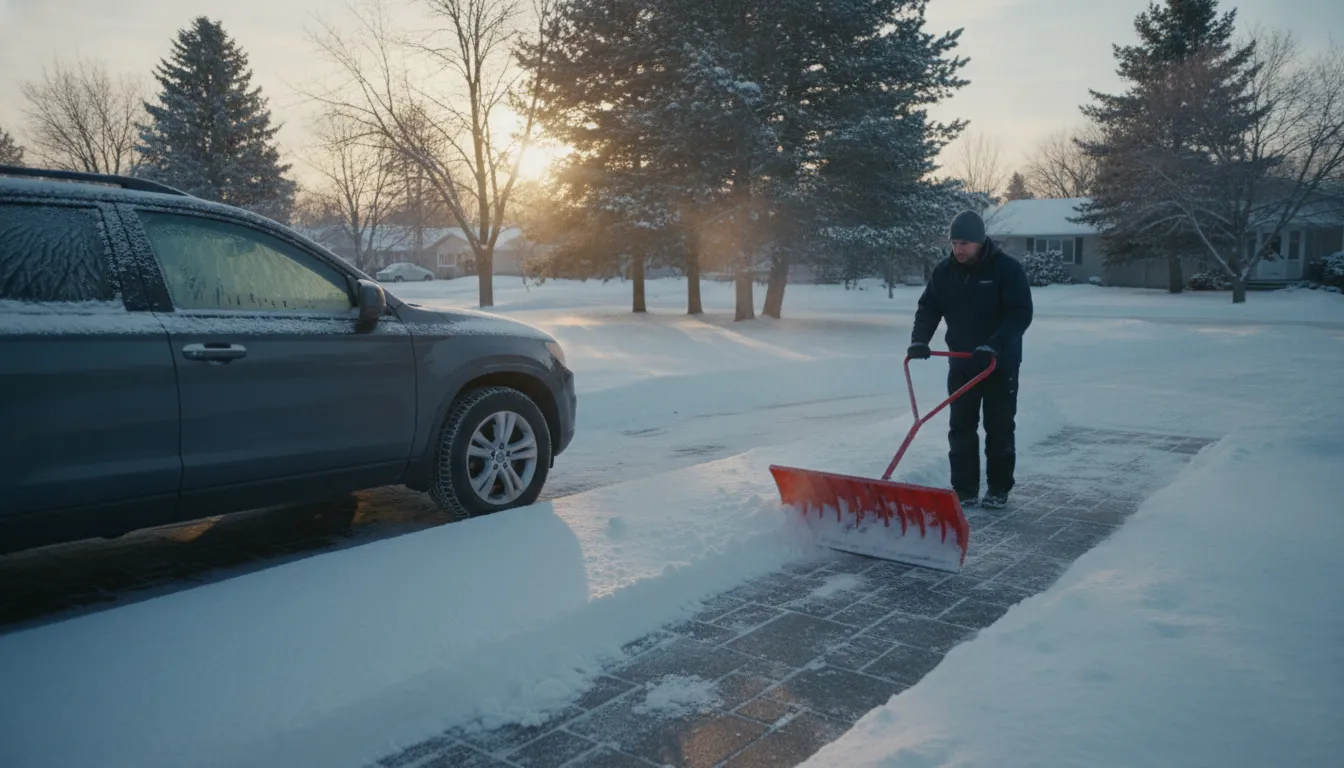
One tool moves snow. The other prepares the vehicle.
After a storm, the sequence is simple. Use the pusher to open the route from the garage or parking area. Use the shovel for steps, edges, and lifting. Then use the vehicle scraper to clear the surfaces you need for visibility and travel. Each tool stays in its lane.
The EDGE also stows flat in a trunk, back seat, or vehicle floor. That makes it easier to keep the vehicle tool where the problem occurs instead of searching for it in a shed. Its design can also serve as a portable tray or protective floor mat, so it has a role beyond the first snowfall.
How should you choose a winter tool by surface and use case?
Start with the surface, then match the tool to the motion. Pushers move loose snow across open ground. Shovels lift and place snow in confined areas. Vehicle scrapers clear snow and ice from cars. Powered equipment belongs in the conversation when the area, depth, or frequency exceeds a manual setup.
| Task | Best starting point | Why |
|---|---|---|
| Broad driveway | Snow pusher. | Moves loose snow forward with less repeated lifting. |
| Steps and doorways | Snow shovel. | Provides control and lets you lift into a precise location. |
| Packed ice on ground | Ice-specific method. | Frozen buildup may need to be loosened before removal. |
| Windshield and windows | Vehicle scraper. | Designed for close work on vehicle surfaces. |
| Large property or frequent heavy storms | Powered snow equipment or a service. | Manual tools may not match the area or workload. |
Storage is part of the decision. A long-handled pusher needs a dedicated spot. A shovel may hang more easily, but it still needs to be accessible before the storm. A flat vehicle scraper can live in the car, where it is ready when frost or snow arrives.
Effort matters as well. Choose the motion that fits the surface instead of assuming the widest tool is always best. Push where the snow can slide. Lift only when placement requires it. Break large jobs into smaller sections and stop when the load becomes difficult to control.
Finally, separate manual clearing from equipment needs. A pusher can be valuable for a home driveway, but it is not a substitute for a plow. Snow blower, or professional service when the property or conditions demand more capacity. The best tool is the one that fits the size, surface, and condition of the job.
Frequently Asked Questions
The short version is simple: snow pushers are best for moving manageable snow across open ground. They are not a complete replacement for shovels, ice tools, powered equipment, or vehicle scrapers. Choose one when its motion matches the surface and the work you need to do.
Are snow pushers better than snow shovels?
Neither tool wins every job. A pusher is useful when loose snow can move forward across a driveway or walkway. A shovel is more versatile when snow must be lifted, placed precisely, or cleared from steps and tight spaces. Many homes benefit from keeping both available.
What is better, a snow plow or a snow pusher?
That depends on the area and the equipment you already use. A manual pusher can suit a homeowner clearing a manageable driveway. A plow or other powered equipment may make more sense for larger properties, longer routes, or repeated heavy accumulation. Neither category is a vehicle window scraper.
Is a snow pusher better than a bucket?
For loose snow on an open, mostly level surface, a pusher matches the job directly. A bucket can be more versatile when attached to suitable powered equipment and used to scoop or relocate snow. Choose based on surface size, snow depth, available equipment, and storage.
Do I still need a vehicle scraper if I own a snow pusher?
Yes, if you need to prepare a vehicle. A driveway pusher is for ground surfaces. A vehicle scraper is for windows, roofs, hoods, and wiper areas. The EDGE is designed for that vehicle-prep role with a broad, flat format that stows in the vehicle.
What is the best snow removal tool for older adults?
There is no single answer for every person or storm. A pusher can reduce lifting when snow is loose, but it still requires exertion. Consider the person's health, the snow condition, the size of the area, and whether another person or a professional service should handle the work. Stop when the task becomes difficult to control.
- Match the surface. Use a pusher on open ground, a shovel where lifting is needed, and a vehicle scraper on the car.
- Reduce the load. Take smaller passes when snow is deep, wet, or difficult to move.
- Switch tools when conditions change. Do not force a manual tool into packed ice, large accumulations, or work that exceeds its safe capacity.
Ready to simplify vehicle snow and ice preparation?
A snow pusher can be a smart choice for moving loose snow across a driveway or walkway. It does not replace a shovel for lifting, powered equipment for large jobs, or a vehicle scraper for the car itself. Keep each tool focused on the surface it was designed to handle.
Shop The EDGE for vehicle snow and ice preparation. Its broad push-and-pull design, paint-friendly edge, wiper groove, and flat stowage make it a practical addition to a winter-ready vehicle. Scrape. Stow. Go.